The Vasectomy Reversal Procedure
A vasectomy reversal reconnects the tubes that were blocked during your vasectomy, so sperm can return to the semen and you can try for a natural pregnancy. At Ottawa Vasectomy Reversals, every reversal is performed by a fellowship-trained urologist using an operating microscope, at The Ottawa Hospital – Civic Campus.
Why microsurgery matters
The channel inside the vas deferens is less than half a millimetre wide, and the tubule of the epididymis is even smaller. Reconnecting them accurately takes stitches finer than a human hair, placed under high magnification.
Current Canadian Urological Association guidelines recommend that vasectomy reversal be offered only by surgeons trained in microsurgical technique. Dr. Witherspoon and Dr. Roberts each completed additional fellowship training in male reproduction after their urology residency, with a focus on microsurgical reversal.
When you're comparing surgeons, it's worth asking two questions:
Will the reversal be done using an operating microscope?
Can the surgeon perform a vasoepididymostomy during the same operation if it's needed?
The two types of reversal
There are two ways to reconnect the system. Which one you need is decided during surgery, not beforehand.
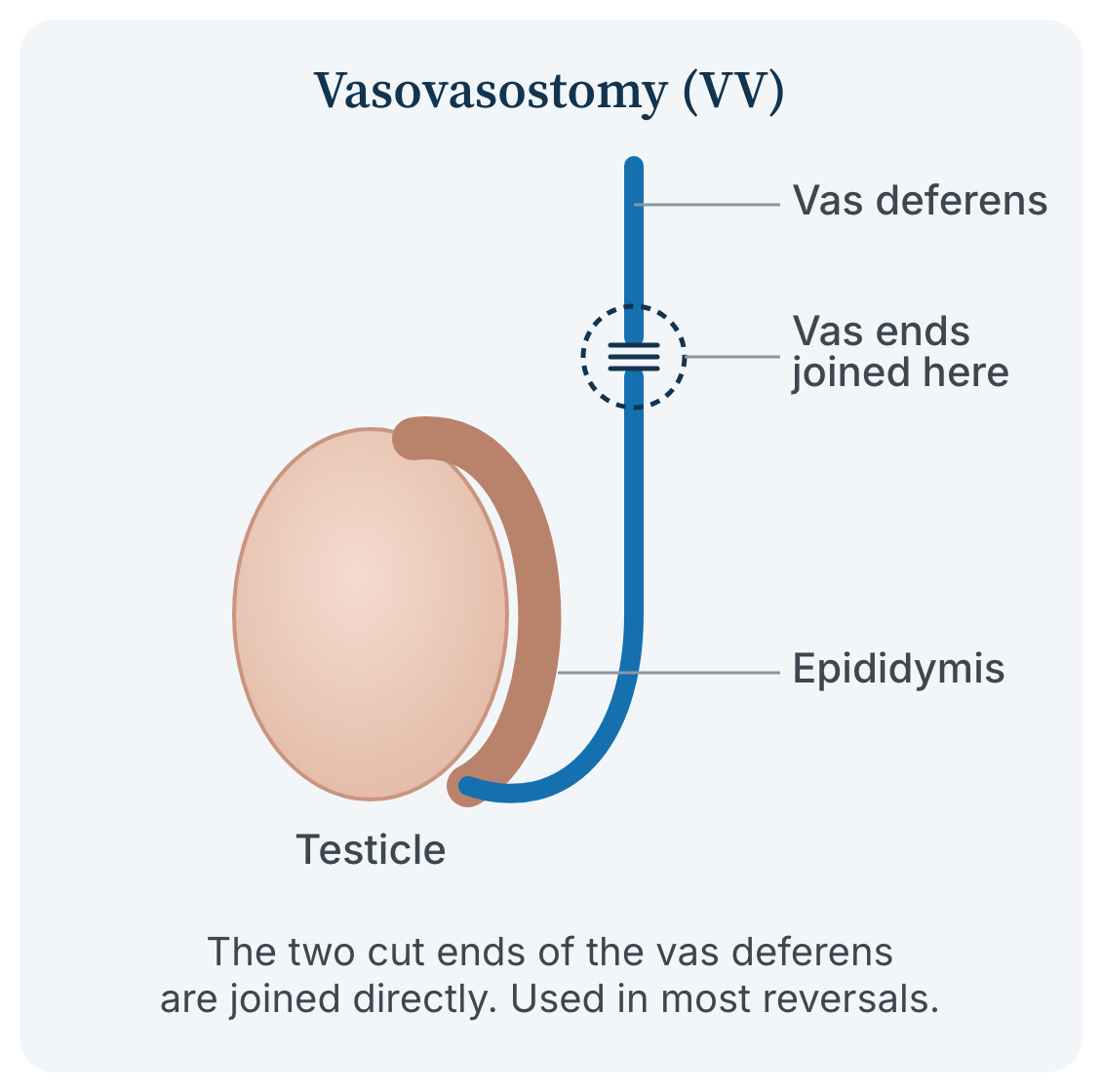
Vasovasostomy (VV)
The two cut ends of the vas deferens are joined directly. This is used when the fluid in the tube closest to the testicle contains sperm, or is clear and watery. It means the system behind the vasectomy site is still open. Most reversals are vasovasostomies.
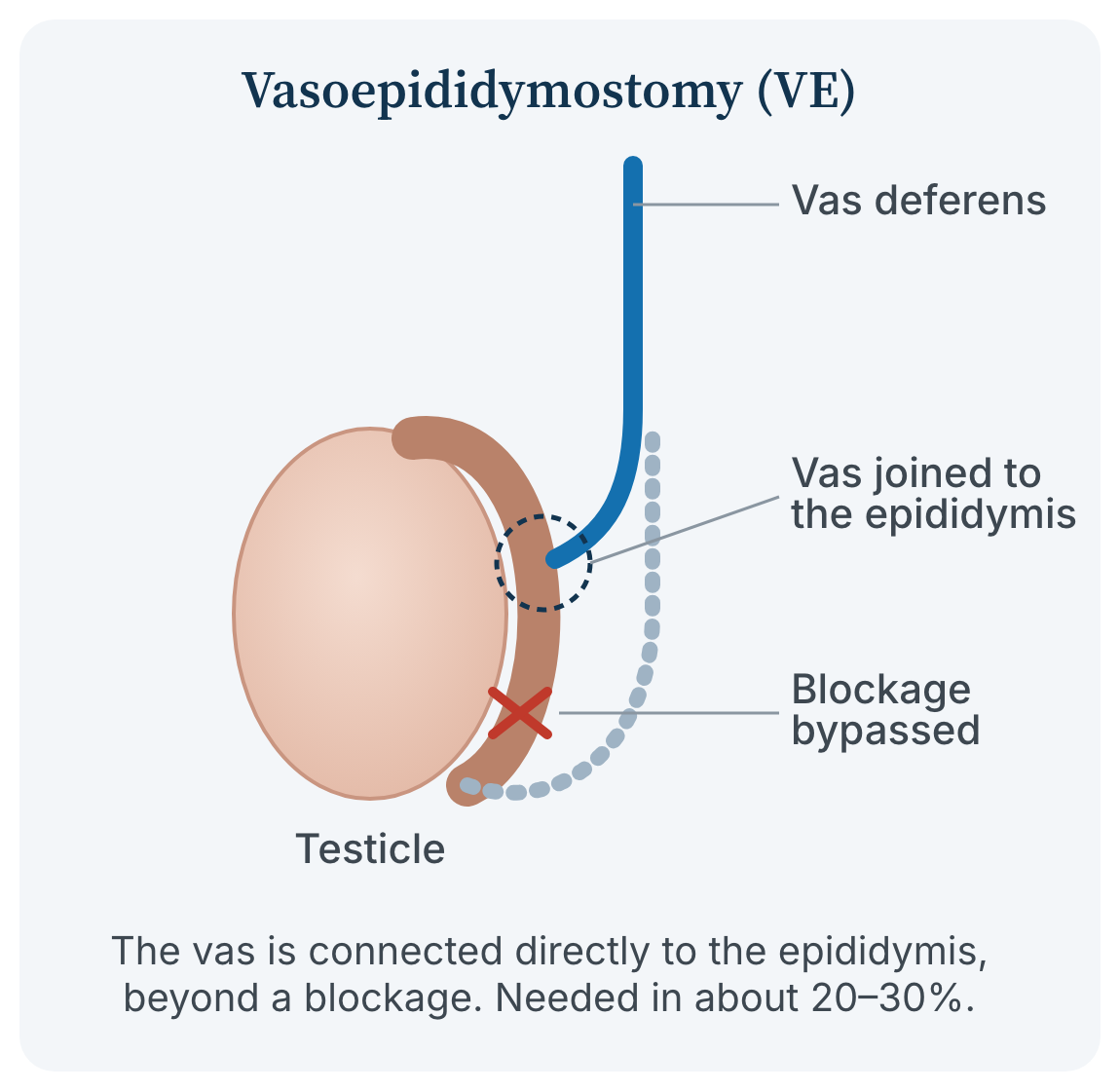
Vasoepididymostomy (VE)
Over time, pressure from the vasectomy can cause a blowout and blockage further back, in the epididymis, the coiled tube where sperm mature. If the fluid in the vas is thick and contains no sperm, joining the vas ends alone won't work. Instead, the vas is connected directly to the epididymis, beyond the blockage.
About 20–30% of patients need a VE on at least one side. It's more technically demanding, and many surgeons who offer reversals aren't trained to perform it. Both of our surgeons are, so if a VE is needed, it's done in the same operation. You won't need a second surgery.
Our techniques
Depending on your anatomy, your surgeon may use a mini-incision approach to keep the incision small, and a micro-dot multi-layer technique. With micro-dot multi-layer, the stitch positions are precisely mapped and the tube is closed in layers, so the two ends line up accurately.
Are you a good candidate?
Most males who have had a vasectomy can have a reversal, including those whose vasectomy was many years ago. Things we'll review at your consultation include:
Time since your vasectomy. The longer it has been, the more likely a vasoepididymostomy will be needed.
Your partner's age and fertility. These strongly affect the chance of pregnancy. Depending on your partners age or known fertility concerns, we may suggest they also see a fertility specialist.
Your overall health, and any previous surgery in the groin or scrotum.
For some couples, sperm retrieval combined with IVF may be a better option. We'll talk through both, so you can choose what's right for your family.
What to expect
1. Consultation
You'll meet with your surgeon to review your history, examine you, and discuss your options, and chances of success.
2. Before surgery
Typically you'll stop eating and drinking after midnight the night before. Because you'll have a general anesthetic, you'll need someone to drive you home.
3. Surgery day
The reversal is a day surgery. You'll have a general anesthetic so you're completely still and comfortable. The operation usually takes about 2–3 hours, depending on whether a vasoepididymostomy is needed. Most patients go home a few hours after surgery.
4. Recovery at home
Expect swelling and discomfort for the first few days. This is usually managed with ice packs, supportive underwear and regular pain relievers.
Most men return to a desk job within 7–10 days and to physical work within 21 days.
Avoid heavy lifting, strenuous exercise and sexual activity for about 3–4 weeks, to protect the new connection while it heals.
5. Follow-up and semen testing
We check a semen analysis about 3 months after surgery. Sperm counts and movement often keep improving for several months after that. After a vasoepididymostomy, sperm can take 6–12 months or longer to appear.
Success rates
Success depends mainly on how long ago your vasectomy was, and on whether a vasoepididymostomy is needed. In large published studies, sperm return to the semen in roughly 70–97% of men after a microsurgical vasovasostomy. Rates are highest when the vasectomy was within the last few years. Success rates after a vasoepididymostomy are lower, but it often makes a reversal possible when a vasovasostomy alone would not work.
Pregnancy rates are lower than sperm-return rates, because they also depend on your partner's age and fertility. Your surgeon will discuss your individual chances at your consultation.
Risks
Vasectomy reversal is a safe, well-established operation, but like any surgery it has risks. These include:
bleeding or a collection of blood in the scrotum (hematoma);
infection;
ongoing discomfort, which is uncommon;
the reversal not working, or the connection narrowing again over time.
Some couples choose to freeze sperm found during the operation as a backup. Please speak to your surgeon if you are interested in this.